
Why Designers Choose Pale Hardwood Faces for Joinery
Okoume brings something rare to joinery specification: a hardwood face that is pale, uniform and calm to work. Dongstar Wood describes its Okoume Plywood with a natural veneer in a pale red to pinkish tone, a relatively low density compared with many hardwood plywoods, and support for CE EN13986 compliance with E1 and E0 glues.
Key takeaways
- Designers specify the surface before the structure: okoume's natural veneer runs warm pinkish red with a grain uniform enough to stain without sorting.
- Density is relatively low compared with many hardwood plywoods, which keeps handling easy and dimensional stability high.
- Compliance support includes CE EN13986, with low-emission E1 and E0 glues.
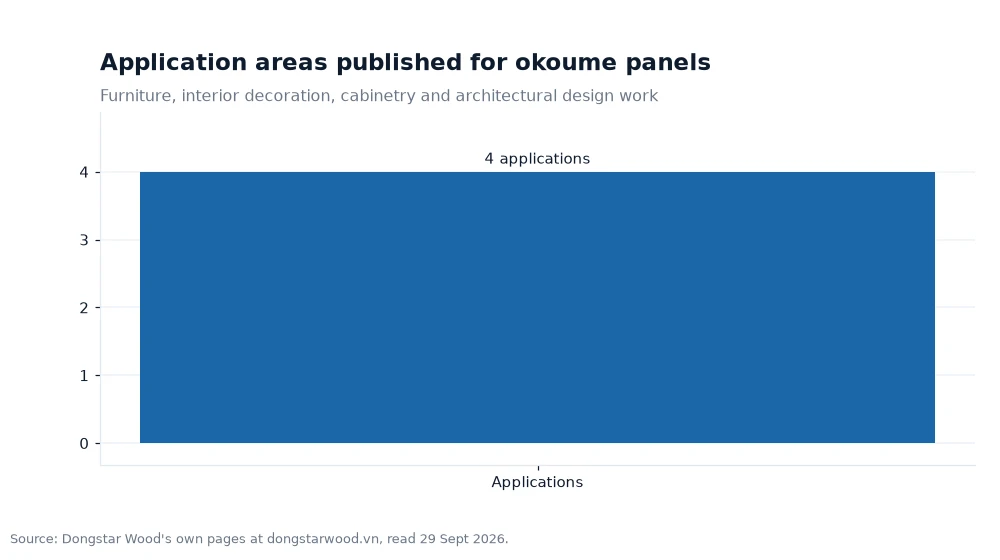
- Applications named on the page: furniture, interior decoration, cabinetry and architectural designs.
The visual character of okoume
Okoume is a pale red to pinkish timber with a uniform grain structure, and that uniformity is the design feature. Where birch is cream and calm, okoume is warm and quiet; where oak is bold, okoume is a background. For joinery — doors, trims, decorative accents, cabinet faces — a background face is often exactly what is wanted, because it sits behind the hardware, the fittings and the room.
The page describes the surface as smooth, calibrated and precision-pressed, with tight thickness tolerance. Those are the properties that let a joiner run a door through a moulder and get the same profile at both ends, and let a shop fit fifty identical cabinet faces without shading them by hand. The pinkish tone deepens slightly with age and with clear coatings, so a specifier who wants the palest result should seal early and test a sample panel before committing to a run.
Density, handling and stability
The page is unusually direct about density: okoume is relatively low density compared with many hardwood plywoods. That sounds like a compromise until it is read as a workshop statement. A lower-density hardwood is easier to handle, easier to machine, and — because the fibres are less rigid — it holds dimensional stability rather than fighting it. The panel stays flat through the seasons instead of cupping and twisting.
For joinery that matters twice. Flat panels take glue bands and edge veneers without springing, and they stay flat after fitting, which is the difference between a door that closes in July and a door that closes the following March as well. The stability claim is the one that matters in a fitted kitchen, where a door that cups will not close flush and a drawer that twists will not run true.
Sourcing and compliance
Per the page's own FAQ, the timber is sustainably harvested Okoume, a species native to Africa. The compliance story is CE EN13986 — the European construction-product standard — supported with low-emission glues in E1 and E0 classes. For a joinery specifier, that combination answers the two questions that come first: where does the wood come from, and what does it emit.
CE EN13986 is the standard that lets a panel be used in construction applications in the European market, and the page states that many manufacturers support it. The E1 and E0 glue classes cover the emission side, so the panel can be specified for interiors without a separate emission argument. The sustainably harvested claim and the CE EN13986 support are published together, which lets a specifier answer the sourcing question and the compliance question from the same page.
Pressing, tolerance and finishing
The page describes calibrated veneers, precision pressing and a tight thickness tolerance. Calibrated means the veneer is sanded to a consistent thickness before pressing, so the face comes out of the press uniform rather than needing a heavy sand afterwards. Precision pressing and tight tolerance mean the panel is the thickness it is sold as, across the whole sheet.
The surface accepts paints, stains, laminates and clear sealers, which is the full joinery finish palette. A pale, uniform face takes a clear sealer and stays pale; it takes a stain and goes the colour of the stain rather than fighting it; it takes a laminate and gives the adhesive a smooth, consistent bed. A tight thickness tolerance also means that a batch of panels can be nested on a CNC router with one thickness setting rather than a setting per board, which is a quiet saving in machining time.
Where okoume panels are specified
Furniture comes first on the application list — chairs, tables, cabinets, wardrobes — then interior panelling such as wall cladding, ceiling panels and partitions, then joinery and architectural elements like doors, trims and decorative accents. Marine interiors and light construction are named too: yacht cabinetry, boat interiors and lightweight structural elements, where the low density pays for itself in weight saved.
That spread is the argument for the species. The same board that lines a boat cabin in a warm pale face can be specified for a hotel wardrobe or a retail counter, because the visual character is calm enough for all three and the machining quality is consistent across the range.
| Design requirement | Published okoume property | Joinery benefit |
|---|---|---|
| Visual calm | Pale red to pinkish tone, uniform grain | Sits behind hardware and fittings |
| Handling | Relatively low density | Easier machining, better stability |
| Compliance | CE EN13986, E1 and E0 glues | Construction and interior use in Europe |
| Finishing | Accepts paints, stains, laminates, sealers | Full joinery finish palette |
Worked example: a cabinet run from sheet area
Area arithmetic sizes a joinery order before the quotation. A fitted wardrobe run needs 15 m² of panel for carcasses, doors and shelving. At 1.25 × 2.5 = 3.125 m² per board, 15 ÷ 3.125 = 4.8 — five boards before cutting loss. Add a sheet for offcuts and the order is six.
The same calculation checks the finish route. A clear-sealed face wants the most uniform grade available, because the sealer reveals everything; a painted face tolerates more character. The area does not change with the finish, but the grade does.
Frequently asked questions
What does okoume look like?
The veneer is natural Okoume, pale red shading to pinkish, with a uniform grain structure. The tone is warm and quiet, which is why it works as a background face behind hardware and fittings in joinery.
Is okoume a hardwood?
Yes, and the page describes it as relatively low density compared with many hardwood plywoods. That lower density makes it easier to handle and machine while keeping good dimensional stability.
What compliance support is available?
The page states support for CE EN13986 compliance, with low-emission glues in the E1 and E0 classes. That covers the construction-product and emission paperwork a European joinery specification asks for.
Specifying the pale face on purpose
Okoume is chosen for a reason, and the reason is usually the face. Read the Okoume Plywood Supplier page for the veneer, density and compliance details, then review the company profile for the factory behind them. Where the design calls for a cooler pale face instead, the birch range covers the clear-finish duty. The joinery that looks effortless is the joinery that was specified.
Details cited in this article trace to the mill's website retrieved on September 29, 2026[1].