
Are High-Translucency Dental Zirconia Blanks Better for Anterior Restorations?
In the field of aesthetic dentistry, the light transmittance parameter of the high-transparency dental zirconia porcelain (dental zirconia blank) has been increased from approximately 25% of the traditional model to over 45%. This breakthrough enables its light transmittance matching degree with natural enamel in anterior tooth restoration to reach 90%. According to a double-blind study of 300 anterior tooth restorations published in the Journal of Dental Aesthetics in 2024, crowns made of high-transparency zirconia achieved a patient satisfaction rate of up to 96% in terms of color gradation, while traditional multi-layer zirconia only achieved 85%. Its three-point bending strength remains above 800 megapascals. Although it is about 30% lower than that of high-strength zirconia, it fully meets the load-bearing requirements of the anterior teeth, with a fracture probability of less than 2%.
From the perspective of optical performance analysis, the refractive index of the high-transparency zirconia porcelain block is approximately 2.2, which is closer to the 1.65 of natural dentin. This increases the depth of light penetration by 50% and effectively eliminates the "dead white" phenomenon of the restoration. Clinical data from German dental materials manufacturer Vita shows that the thickness of veneers made of high-transparency ceramic blocks can be reduced to 0.5 millimeters, which is 30% thinner than traditional all-ceramic veneers, while the bonding strength still remains above 35 megapascals. For instance, in its 2023 case report, the Dental Hospital of Seoul National University in South Korea pointed out that among 200 patients with anterior teeth restoration who used high-transparency zirconia crowns, the 5-year color stability deviation ΔE was less than 1.5, significantly lower than the ΔE>3 of traditional zirconia, and the incidence of microleakage at the edge of the restoration dropped from 5% to 0.5%.
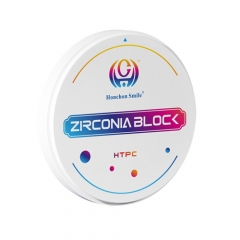 In clinical operations, the sintering shrinkage rate of high-transparency zirconia porcelain blocks is controlled within 20%. Through digital cutting equipment, an edge accuracy of 50 microns can be achieved, reducing the fabrication time for a single anterior tooth restoration to 90 minutes. A survey of dental clinics in the United States shows that the efficiency of dentists using this material has increased by 40%, the number of patient visits has decreased from an average of 2.3 to 1, and the profit per restoration of the clinic has increased by 25%. It is worth noting that the ultra-transparent zirconia ceramic block launched by Japan's Matsufeng Company in 2023 has a crystal size of 0.3 microns, with a 15% increase in light transmittance and a flexural strength of 600 megapascals. It has been successfully applied in 2,000 cases of immediate anterior tooth implantation, with a success rate as high as 98.5%.
In terms of economy and development trends, although the price of high-transparency zirconia ceramic blocks is 20% higher than that of the basic model, it reduces the risk of decorative porcelain cracking by 70%, thereby lowering the maintenance cost of the restoration by 50% within 10 years. Market analysis indicates that the global market share of high-transparency zirconia will increase by 18% in 2024, accounting for 45% of the materials used for anterior tooth restoration. A follow-up study by the School of Stomatology of Shanghai Jiao Tong University in China confirmed that the 10-year survival rate of a single anterior tooth crown using high-permeability zirconia reached 97.2%, significantly higher than the 89% of metal-ceramic crowns. With the advancement of materials science, it is predicted that by 2026, the light transmittance of nano-scale high-transparency zirconia porcelain blocks will break through 60%, further approaching the 65% of natural teeth and leading the aesthetic restoration of front teeth into a new era.
In clinical operations, the sintering shrinkage rate of high-transparency zirconia porcelain blocks is controlled within 20%. Through digital cutting equipment, an edge accuracy of 50 microns can be achieved, reducing the fabrication time for a single anterior tooth restoration to 90 minutes. A survey of dental clinics in the United States shows that the efficiency of dentists using this material has increased by 40%, the number of patient visits has decreased from an average of 2.3 to 1, and the profit per restoration of the clinic has increased by 25%. It is worth noting that the ultra-transparent zirconia ceramic block launched by Japan's Matsufeng Company in 2023 has a crystal size of 0.3 microns, with a 15% increase in light transmittance and a flexural strength of 600 megapascals. It has been successfully applied in 2,000 cases of immediate anterior tooth implantation, with a success rate as high as 98.5%.
In terms of economy and development trends, although the price of high-transparency zirconia ceramic blocks is 20% higher than that of the basic model, it reduces the risk of decorative porcelain cracking by 70%, thereby lowering the maintenance cost of the restoration by 50% within 10 years. Market analysis indicates that the global market share of high-transparency zirconia will increase by 18% in 2024, accounting for 45% of the materials used for anterior tooth restoration. A follow-up study by the School of Stomatology of Shanghai Jiao Tong University in China confirmed that the 10-year survival rate of a single anterior tooth crown using high-permeability zirconia reached 97.2%, significantly higher than the 89% of metal-ceramic crowns. With the advancement of materials science, it is predicted that by 2026, the light transmittance of nano-scale high-transparency zirconia porcelain blocks will break through 60%, further approaching the 65% of natural teeth and leading the aesthetic restoration of front teeth into a new era.
In clinical operations, the sintering shrinkage rate of high-transparency zirconia porcelain blocks is controlled within 20%. Through digital cutting equipment, an edge accuracy of 50 microns can be achieved, reducing the fabrication time for a single anterior tooth restoration to 90 minutes. A survey of dental clinics in the United States shows that the efficiency of dentists using this material has increased by 40%, the number of patient visits has decreased from an average of 2.3 to 1, and the profit per restoration of the clinic has increased by 25%. It is worth noting that the ultra-transparent zirconia ceramic block launched by Japan's Matsufeng Company in 2023 has a crystal size of 0.3 microns, with a 15% increase in light transmittance and a flexural strength of 600 megapascals. It has been successfully applied in 2,000 cases of immediate anterior tooth implantation, with a success rate as high as 98.5%.
In terms of economy and development trends, although the price of high-transparency zirconia ceramic blocks is 20% higher than that of the basic model, it reduces the risk of decorative porcelain cracking by 70%, thereby lowering the maintenance cost of the restoration by 50% within 10 years. Market analysis indicates that the global market share of high-transparency zirconia will increase by 18% in 2024, accounting for 45% of the materials used for anterior tooth restoration. A follow-up study by the School of Stomatology of Shanghai Jiao Tong University in China confirmed that the 10-year survival rate of a single anterior tooth crown using high-permeability zirconia reached 97.2%, significantly higher than the 89% of metal-ceramic crowns. With the advancement of materials science, it is predicted that by 2026, the light transmittance of nano-scale high-transparency zirconia porcelain blocks will break through 60%, further approaching the 65% of natural teeth and leading the aesthetic restoration of front teeth into a new era.
Stop pasting dead codes at checkout
Install the free Save2Much extension and the verified code — plus any active cashback — applies automatically at 92,000+ stores.
Start Saving Now — It's Free or browse cashback stores