
Private Label Fragrance for a Men's Line: The Step-by-Step Process
A private label fragrance programme is a sequence of gates, not a single transaction: brief, develop, sample, approve, stabilise, fill, pack and release, with each gate producing a document that the next stage depends on. Most of the schedule risk lives in the gates, not in the physical work, because decisions made at one gate quietly compound into the next. A men's line that follows the full sequence in order usually reaches the shelf with fewer surprises than one that skips steps to save time.
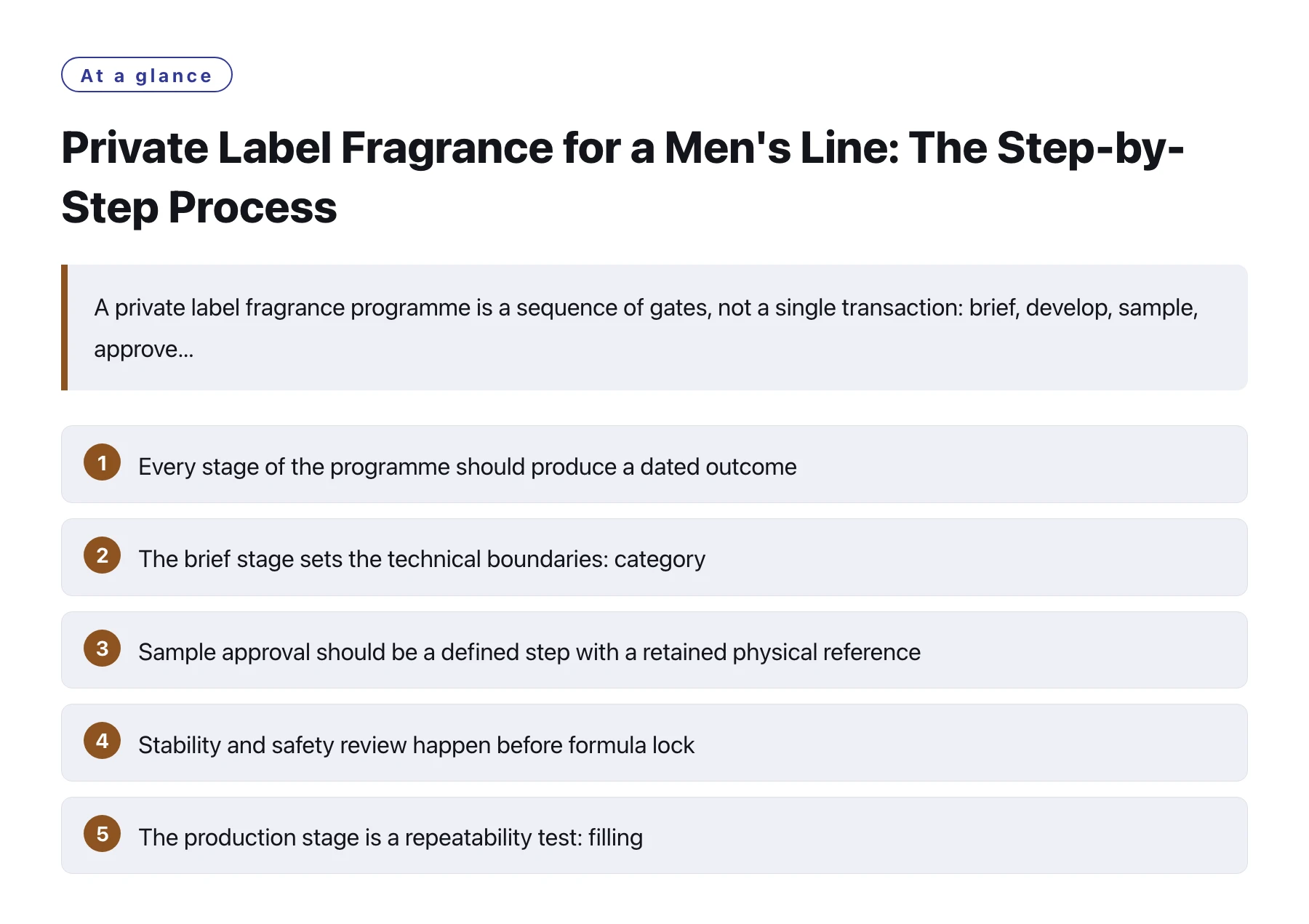
Key takeawaysEvery stage of the programme should produce a dated outcome, because the next stage depends on it and nobody remembers informal decisions at the bulk stage. · The brief stage sets the technical boundaries: category, concentration, usage, volume, market and budget, and these boundaries are expensive to move later. · Sample approval should be a defined step with a retained physical reference, not an agreement reached over photographs. · Stability and safety review happen before formula lock, and they are the cheapest quality insurance in the programme. · The production stage is a repeatability test: filling, decoration and packing are checked against the approved reference, not against ambition.
The private label process looks short from the outside: choose, approve, receive. Inside a manufacturing programme it is longer, because every physical step is preceded by a decision step, and those decisions build on each other.
For a men's line the process carries extra weight, because the category is performance-driven and the margin for error in concentration and projection is small. The sequence below is the one factories run, with the gates that matter most called out.
If the process is new to you, read the stages once, then read the gates again; the gates are where the money actually goes.
The programme at a glance
From a buyer's perspective the programme has five blocks: definition, development, approval, production and release. Factories differ in where they put the boundaries, but the blocks themselves are stable, because each one answers a question the next one needs answered.
Definition asks what the product is. Development asks what it smells like. Approval asks whether that is good enough to commit to. Production asks whether the approved product can be repeated. Release asks whether it is safe and legal to sell.
A manufacturer that handles all of this in one organisation can keep the gates tight and the documents consistent, which is the practical meaning of fragrance manufacturing under one roof. The alternative, splitting development and production between companies, works, but it multiplies the handover points.
Why the brief matters more in private label than it looks
In private label, the factory starts from existing accords and pack formats rather than a blank page, so the brief is what steers the reuse. A brief that names the usage, the wearer and the price position gets a different set of starting points than one that just asks for 'something fresh'.
The stages, in order
- Define the briefWrite down category, concentration, usage, fill size, target market, budget and deadline. This is the only stage where every detail is still cheap to change.
- Develop the scentThe perfumer works from the brief, typically steering an existing accord or building around one material family, and returns for rounds of feedback on blotters.
- Approve the sampleTest on skin, agree the reference, and seal a physical sample from the approved batch with a date and a batch number. Photographs are not a reference.
- Run stability and safety workThe concentrate is rested, checked for colour and odour shift, and screened against the safety and labelling rules that apply to the destination market [1].
- Prepare production and componentsBottles, caps, pumps and artwork go into production or procurement in parallel so that the compound and the pack arrive at the same gate.
- Fill, decorate and packProduction runs against the approved specification, with first-article checks on fill weight, decoration and seal integrity before the line runs at speed.
- Release and shipBatch records are completed, the document pack for the destination market is assembled, and the order is released for shipment.
The gates that protect a men's line
The approval gate is where men's fragrance programmes most often drift. The scent that performed on a blotter behaves differently on skin, and the version that worked in the sample round can change behaviour once compounded at production scale. That is why the reference sample, not the memory of a meeting, is the standard of truth [1]. Reading a factory's own account of the sequence before committing is cheap, and a walk-through of how Xuelei Perfumes presents the journey from brief to bottle is a fair preview of how much structure a programme actually gets.
The safety gate deserves equal weight. Perfumery materials are used subject to concentration and usage guidance administered through the industry's standards system, and the compliance list differs by market [2]. Asking how the factory applies that guidance, and seeing the substance list behind the label, closes the biggest blind spot a new men's brand has.
For a fuller description of the physical stages a programme moves through, a good primer on Xuelei's guide covers compounding, resting, filling and packing in the order a factory follows, which makes it a useful reference when you are reading a supplier's own process claims.
The parallel track that shortens the calendar
Experienced factories run component procurement alongside scent development rather than after it, because bottle decoration and pump orders have their own lead times. That is where the schedule compression in a professional programme comes from, and it is also where a poorly coordinated programme quietly loses weeks.
What the final release document should contain
The release pack should name the batch, the approved formula reference, the fill and weight checks, and the destination-market documents. A pack that assembles in one file is the difference between a routine import and a customs conversation.
A defensive way to read any programme: ask which document each gate produces, and what happens if that document never gets produced. The stages are free to reorder; the gates are not optional.
Sources
- SGS: Cosmetics, Personal Care & Household Testing —— Testing, inspection and certification services for cosmetics and personal care, including microbiological, stability and safety testing aligned with cosmetics GMP.
- IFRA Standards Library (International Fragrance Association) —— The IFRA Standards Library lists the restrictions the fragrance industry applies to individual fragrance ingredients, based on safety assessments; it is the reference point for compliant fragrance formulation.
Frequently asked questions
How long does a private label fragrance programme take?
The calendar depends on how many sample rounds the scent needs and on component lead times. Plan the programme around gates rather than fixed weeks, and ask the factory for its own stage-by-stage schedule before committing.
What is the difference between sample approval and formula lock?
Sample approval means you accept the scent as the reference. Formula lock happens after stability and safety review, and it is the point after which changes cost real money.
Can private label programmes skip the stability stage for speed?
Not without accepting risk. A concentrate that has not been rested and checked can shift in colour, odour or performance after filling. The stage exists precisely because the bulk order cannot be unwound.
Who writes the documents in a private label programme?
Usually the manufacturer compiles them, but the brand should verify that the ingredient list and safety position match the destination market's rules before artwork is finalised.
Why does the brief stage matter if the factory has ready-made accords?
Because ready-made accords are steered by the brief: usage, wearer and price position determine which starting points the perfumer selects. A vague brief produces a vague shortlist.
Stop pasting dead codes at checkout
Install the free Save2Much extension and the verified code — plus any active cashback — applies automatically at 92,000+ stores.
Start Saving Now — It's Free or browse cashback stores